
Why Every Business Needs a Digital Strategy
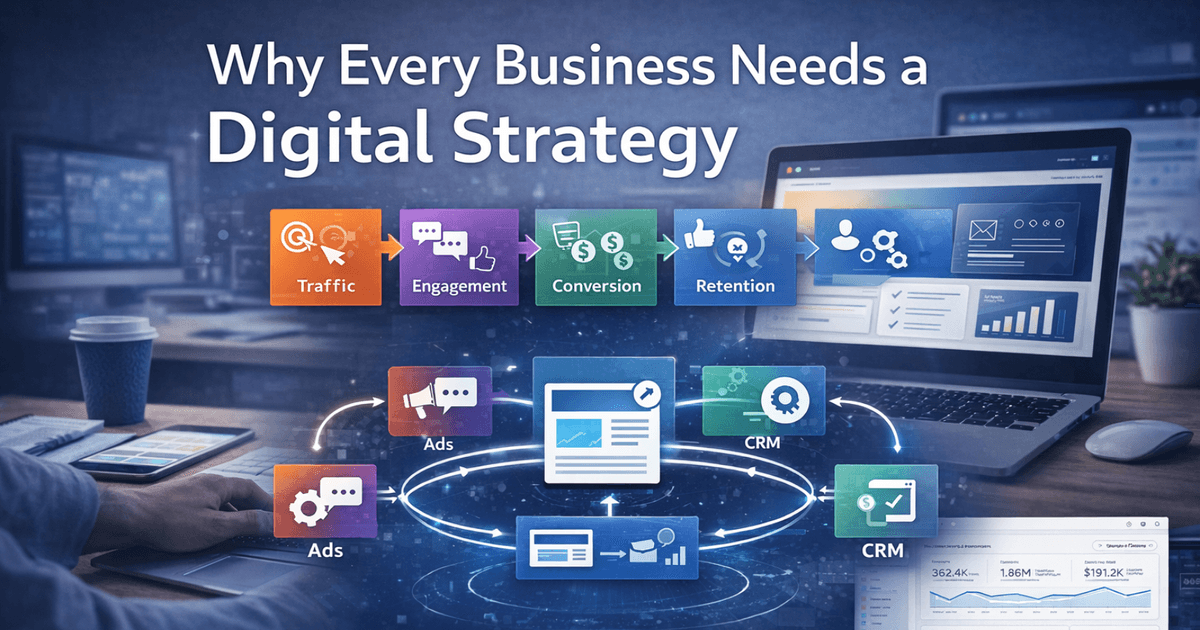
A comprehensive exploration of why a clear digital strategy is essential for modern businesses. This article outlines how digital strategy drives growth, aligns marketing efforts, improves customer experience, and creates a competitive advantage in an increasingly online-first world.
Why Every Business Needs a Digital Strategy
In today’s business landscape, digital is no longer optional.
It is foundational.
Customers discover, evaluate, and engage with businesses online before making decisions. Without a clear digital strategy, businesses operate reactively rather than strategically.
The result is inconsistent growth, wasted marketing spend, and missed opportunities.
A digital strategy provides direction, structure, and measurable outcomes. It transforms digital presence from a collection of disconnected tools into a cohesive growth system.
What Is a Digital Strategy?
A digital strategy is a structured plan that defines how a business uses digital channels, platforms, and technologies to achieve its goals.
It aligns:
- Website performance
- Marketing campaigns
- Content strategy
- Customer experience
- Data and analytics
- Sales processes
Rather than treating these as separate activities, a digital strategy integrates them into a unified system.
This ensures every digital effort contributes to business growth.
1. Digital Strategy Aligns Business Goals with Execution
Many businesses invest in websites, ads, and content without a clear connection to outcomes.
A digital strategy ensures alignment between:
- Business objectives
- Target audience
- Messaging
- Marketing channels
- Conversion goals
For example:
Instead of running generic ads, a strategy-driven business targets specific customer segments with tailored messaging and clear conversion pathways.
This alignment increases efficiency and improves return on investment.
Without strategy, digital activity becomes fragmented and inconsistent.
2. It Turns Your Website Into a Growth Engine
A website without strategy is a static asset.
A website with strategy becomes a performance-driven platform.
Strategic websites are designed to:
- Capture leads
- Guide user journeys
- Communicate value clearly
- Support marketing campaigns
- Integrate with CRM systems
Every page serves a purpose within a broader conversion framework.
Businesses that treat their website as a core part of their digital strategy see significantly higher engagement and conversion rates.
3. It Maximizes Marketing ROI
Digital marketing without strategy often leads to wasted budget.
Businesses may invest in:
- Google Ads
- Social media campaigns
- SEO efforts
But without coordination, these efforts produce inconsistent results.
A digital strategy ensures that all marketing channels work together.
For example:
- Ads drive traffic to optimized landing pages
- Landing pages guide users toward conversion
- Data from conversions informs future campaigns
This creates a feedback loop that improves performance over time.
The result is more efficient spending and better outcomes.
4. It Improves Customer Experience
Customer experience is a critical factor in modern business success.
A digital strategy ensures that users encounter:
- Consistent messaging across platforms
- Seamless navigation and usability
- Fast, responsive interactions
- Clear and intuitive user journeys
When digital touchpoints are aligned, customers experience less friction and greater clarity.
This increases satisfaction, trust, and likelihood of conversion.
Businesses that ignore digital experience risk losing customers to competitors with smoother interactions.
5. It Enables Data-Driven Decision Making
One of the greatest advantages of digital systems is access to data.
However, data without strategy is noise.
A digital strategy defines:
- What metrics matter
- How performance is measured
- How insights are used to improve outcomes
Key performance indicators may include:
- Conversion rates
- Cost per acquisition
- User engagement
- Retention rates
By analyzing these metrics, businesses can continuously optimize their digital efforts.
Decisions become based on evidence rather than assumptions.
6. It Creates a Scalable Growth Framework
A well-defined digital strategy supports long-term growth.
Instead of constantly starting from scratch, businesses build systems that can scale.
This includes:
- Automated lead generation processes
- Content strategies that build authority over time
- Integrated marketing funnels
- CRM and automation tools
As the business grows, these systems continue to perform and improve.
Scalability becomes a built-in advantage rather than a challenge.
7. It Provides a Competitive Advantage
In competitive markets, strategy separates leaders from followers.
Many businesses still operate without a clear digital roadmap.
This creates an opportunity for those who invest in strategy to outperform competitors.
A strong digital strategy enables businesses to:
- Reach the right audience effectively
- Deliver superior user experiences
- Convert more visitors into customers
- Adapt quickly to market changes
Over time, this leads to stronger brand positioning and sustained growth.
FAQs: Digital Strategy for Businesses
1. What is a digital strategy?
A digital strategy is a plan that outlines how a business uses digital channels and technologies to achieve its goals, including marketing, customer experience, and sales.
2. Why is digital strategy important for businesses?
Digital strategy is important because it aligns digital efforts with business goals, improves efficiency, enhances customer experience, and drives measurable growth.
3. How does a digital strategy improve marketing performance?
It ensures that all marketing channels work together, creating a cohesive system that optimizes traffic, engagement, and conversions.
4. What are the key components of a digital strategy?
Key components include website optimization, content strategy, SEO, paid marketing, analytics, user experience, and automation systems.
5. How can a business develop a digital strategy?
Businesses can develop a digital strategy by defining goals, understanding their audience, analyzing current performance, and aligning digital tools and channels with measurable outcomes.
Conclusion: Digital Strategy Is No Longer Optional
The digital landscape is evolving rapidly.
Businesses that operate without a strategy risk falling behind competitors who approach digital with clarity and structure.
A digital strategy transforms disconnected efforts into a unified system that drives growth, improves customer experience, and maximizes return on investment.
At UjjyaloWeb, digital strategy is at the core of every project, ensuring that websites, marketing, and technology work together to deliver measurable results.
Because in today’s market, success is not defined by having a digital presence.
It is defined by how effectively that presence is managed and optimized.
Enjoyed this article? Let's work together.
Get in Touch →