
Why Beautiful Websites Don’t Always Convert
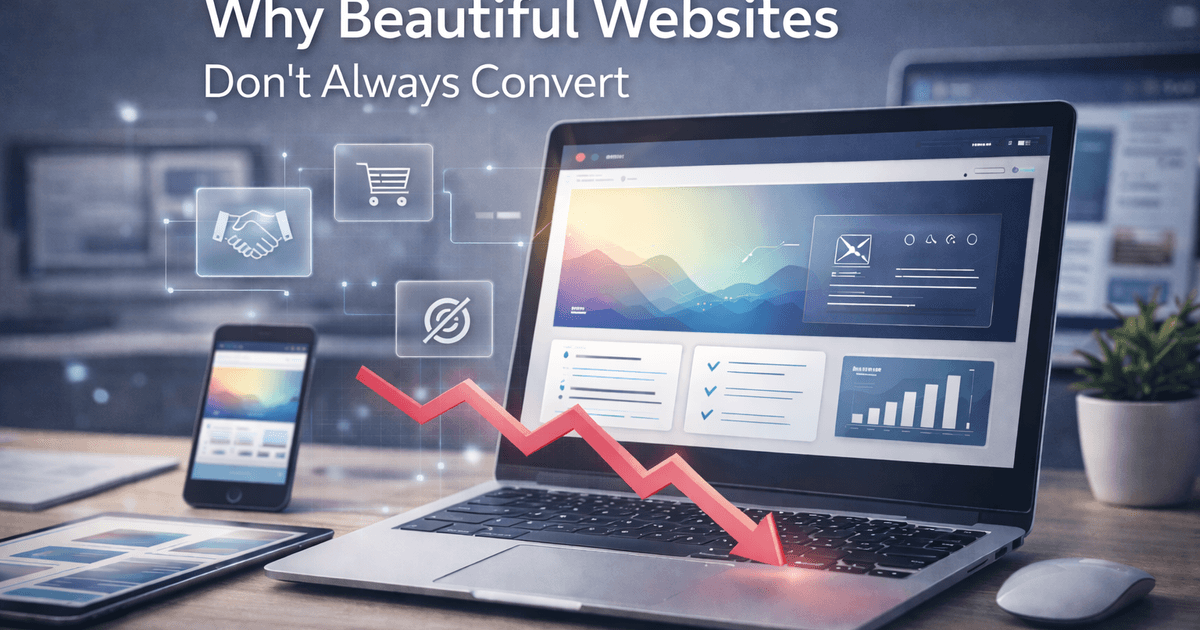
A strategic analysis of why visually stunning websites often fail to generate leads or sales. This article explores the gap between aesthetic design and conversion-focused web strategy, explaining how UX, psychology, clarity, and performance ultimately determine digital success.
Why Beautiful Websites Don’t Always Convert
In the world of web design, aesthetics often receive the most attention. Businesses invest heavily in sleek visuals, creative layouts, and impressive animations hoping to create a memorable online presence.
Yet many of these beautifully designed websites fail to generate leads, sales, or meaningful engagement.
The reason is simple: visual appeal alone does not drive conversions.
High-performing websites are not designed merely to impress visitors. They are engineered to guide users toward specific actions.
Understanding this difference is critical for businesses seeking measurable digital results.
The Difference Between Design and Conversion Strategy
A visually appealing website focuses primarily on appearance. A conversion-focused website prioritizes outcomes.
This means every design decision must answer a strategic question:
Does this help the user move closer to taking action?
That action might be:
- Booking a consultation
- Making a purchase
- Submitting an inquiry
- Signing up for a service
Beautiful websites often fail because they emphasize creativity without considering the user journey.
High-converting websites, by contrast, are structured around clarity, usability, and persuasion.
1. Visual Complexity Often Creates Friction
Designers sometimes prioritize creativity over usability.
Overly complex layouts, heavy animations, and unconventional navigation structures can confuse visitors.
When users cannot quickly understand how to navigate a website, they leave.
Studies consistently show that users form an opinion about a website within seconds. During that short window, they expect immediate clarity.
If visitors cannot quickly determine:
- What the business offers
- How it benefits them
- What action they should take
the opportunity is lost.
In conversion-focused design, simplicity outperforms complexity.
2. Lack of Clear Messaging
A beautiful website can still fail if the messaging is unclear.
Visitors should immediately understand the value proposition.
Many visually impressive websites hide essential information behind abstract headlines or vague statements.
For example:
Instead of saying“Transforming digital possibilities”
a high-converting website might say“Custom Web Development That Generates More Leads for Your Business.”
Clarity converts. Ambiguity does not.
Effective messaging aligns directly with user intent.
3. Weak Call-to-Action Strategy
Another common issue is the absence of strong calls-to-action (CTAs).
Beautiful websites sometimes treat CTAs as secondary elements rather than the primary goal of the page.
Effective CTAs should:
- Stand out visually
- Appear at logical points within the page
- Clearly communicate the benefit of taking action
Examples include:
- Book a Free Strategy Call
- Get a Custom Quote
- Start Your Project Today
Without clear CTAs, even interested visitors may leave without engaging.
4. Poor User Experience Undermines Visual Appeal
User experience plays a critical role in conversion performance.
Even the most visually impressive websites fail if they are difficult to use.
Common UX issues include:
- Slow page loading times
- Confusing navigation
- Mobile usability problems
- Overwhelming information structure
A beautiful interface cannot compensate for frustration.
Users value speed, clarity, and ease of interaction far more than elaborate visual effects.
5. Performance and Speed Affect Conversions
Website performance directly impacts user behavior.
Research shows that even small delays in loading time can significantly reduce conversion rates.
Heavy animations, large images, and complex design elements often slow down websites.
This creates a trade-off between visual sophistication and performance.
High-converting websites strike a balance by maintaining visual quality while prioritizing speed and technical optimization.
Fast websites build trust and maintain user engagement.
6. Lack of Trust Signals
Visitors need reassurance before taking action.
A visually stunning website may still feel untrustworthy if it lacks credibility indicators.
Important trust signals include:
- Client testimonials
- Case studies
- Certifications or awards
- Recognizable client logos
- Clear contact information
These elements reduce hesitation and strengthen confidence in the brand.
Without them, users may admire the design but still hesitate to engage.
7. No Structured Conversion Funnel
Beautiful websites often present information without guiding users through a structured journey.
Conversion-focused websites guide visitors step by step.
A strong conversion funnel typically includes:
- Clear value proposition
- Supporting evidence or benefits
- Social proof
- Risk reduction
- Strong call-to-action
This structure helps visitors move logically from interest to decision.
Without it, users may enjoy browsing but never reach the point of action.
FAQs: Website Design and Conversion Optimization
1. Why do beautiful websites fail to convert?
Beautiful websites may fail to convert because they prioritize visual design over user experience, messaging clarity, and conversion strategy.
2. What is conversion-focused web design?
Conversion-focused web design structures a website to guide visitors toward specific actions such as purchases, sign-ups, or inquiries.
3. How can website design improve conversion rates?
Conversion rates improve when websites emphasize clear messaging, intuitive navigation, strong calls-to-action, fast loading speeds, and trust-building elements.
4. Is UX more important than visual design?
User experience is often more important than aesthetics because usability, clarity, and speed have a greater impact on engagement and conversions.
5. What makes a high-converting website?
High-converting websites combine strategic messaging, intuitive UX, optimized performance, persuasive design elements, and a structured user journey.
Conclusion: Strategy Converts, Not Just Design
A beautiful website can attract attention.
But attention alone does not drive business growth.
Conversions happen when design is supported by strategy, psychology, and user experience.
Businesses that understand this distinction build websites that not only look impressive but also generate measurable results.
At UjjyaloWeb, web design is approached as a strategic performance system, ensuring that every visual element contributes to usability, clarity, and conversion.
Because in the end, the most successful websites are not simply the most beautiful.
They are the most effective.
Enjoyed this article? Let's work together.
Get in Touch →