
The Difference Between a Website That Looks Good and One That Sells
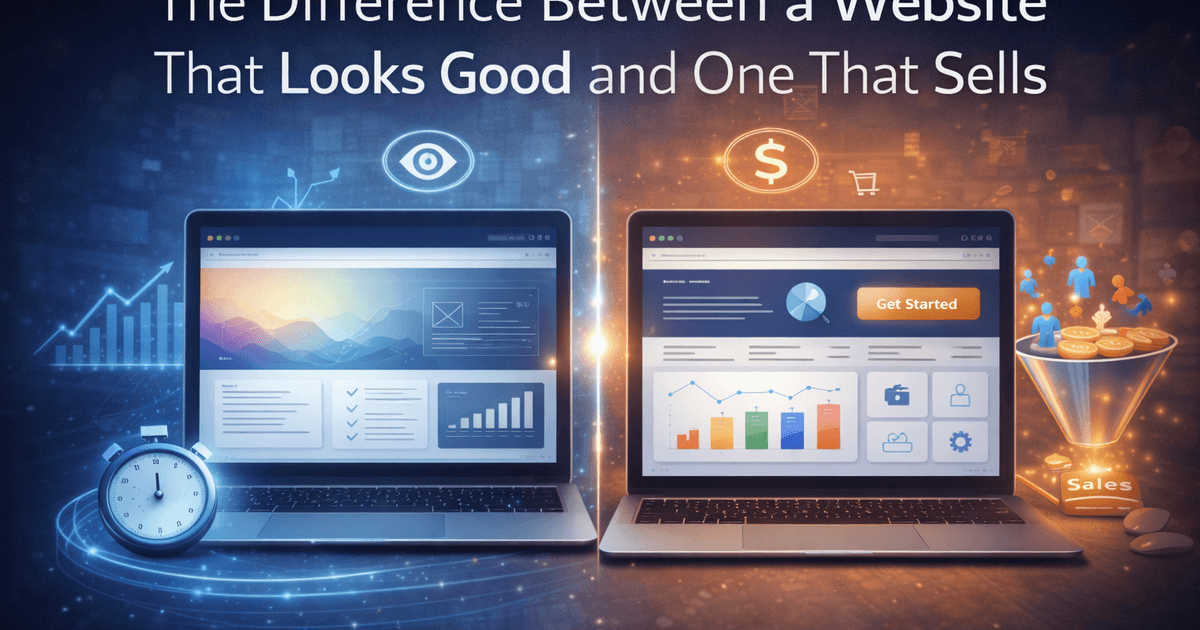
A strategic breakdown of the key differences between visually appealing websites and high-converting sales-driven websites. This article explains how UX, messaging, structure, and conversion strategy determine whether a website generates revenue or simply looks impressive.
The Difference Between a Website That Looks Good and One That Sells
There is a common misconception in web design:
If a website looks good, it will perform well.
It sounds logical. It’s also wrong.
Some of the most visually impressive websites fail to generate leads or sales, while simpler, less flashy websites quietly outperform them.
The difference lies in purpose.
A website that looks good is designed to impress. A website that sells is designed to convert.
Understanding this distinction is critical for any business serious about growth.
Design vs Strategy: The Core Difference
A visually appealing website focuses on aesthetics:
- Colors
- Layout
- Typography
- Animations
A sales-driven website focuses on outcomes:
- Clarity
- User journey
- Messaging
- Conversion flow
The problem is not beauty itself. The problem is when beauty replaces strategy.
A high-performing website integrates design with business objectives.
Every element must serve a purpose.
1. Clarity vs Creativity
Beautiful websites often prioritize creativity over clarity.
They use abstract headlines, artistic layouts, and unconventional navigation.
The result?
Users struggle to understand what the business actually does.
A website that sells prioritizes clarity:
- Clear headline explaining the offer
- Simple structure
- Direct language
- Immediate value communication
Visitors should understand within seconds:
- What you do
- Who it’s for
- Why it matters
Clarity builds trust. Creativity without clarity creates confusion.
2. Guided User Journey vs Passive Browsing
A visually focused website lets users wander.
A conversion-focused website guides users.
High-converting websites are structured intentionally:
- Capture attention
- Explain value
- Build trust
- Reduce risk
- Prompt action
Each section leads naturally to the next.
For example:
- Hero section introduces the value
- Supporting sections explain benefits
- Testimonials build credibility
- CTA drives action
This is not accidental. It is engineered.
3. Strong Messaging vs Vague Branding
Many good-looking websites rely on vague branding language.
Phrases like:
- “We innovate the future”
- “Transforming possibilities”
Sound impressive. Mean nothing.
A website that sells uses specific, benefit-driven messaging:
- “We build high-converting websites that generate leads”
- “Custom accounting solutions for businesses behind on taxes”
Clear messaging connects directly with user intent.
People don’t convert because something sounds impressive.They convert because it solves their problem.
4. Conversion-Focused CTAs vs Decorative Buttons
On many visually designed websites, call-to-action buttons exist but lack strategy.
They are:
- Hard to find
- Poorly worded
- Placed randomly
A website that sells uses CTAs strategically:
- Positioned at key decision points
- Clearly communicates value
- Visually distinct from other elements
Examples:
- Book Your Free Consultation
- Get a Custom Quote
- Start Your Project Today
The difference is intention.
Every CTA is part of a larger conversion flow.
5. Performance vs Visual Overload
Heavy visuals often come at a cost: speed.
Slow websites reduce engagement and conversions.
Users expect fast-loading pages. If a site takes too long, they leave.
A sales-focused website balances design and performance:
- Optimized images
- Minimal unnecessary animations
- Efficient code structure
Speed is not just a technical metric. It directly impacts revenue.
6. Trust Signals vs Pure Aesthetics
A beautiful website can still feel untrustworthy.
Why?
Because it lacks proof.
A website that sells includes:
- Testimonials
- Case studies
- Client logos
- Certifications
- Clear contact information
These elements reassure users and reduce hesitation.
Without trust, even interested visitors will not convert.
7. Data-Driven Design vs Assumption-Based Design
Good-looking websites are often built based on opinion.
High-converting websites are built based on data.
This includes:
- User behavior analytics
- Heatmaps
- A/B testing
- Conversion tracking
Instead of guessing what works, businesses measure and optimize.
This continuous improvement is what separates average websites from high-performing ones.
FAQs: Websites That Convert vs Websites That Look Good
1. What is the difference between a website that looks good and one that sells?
A website that looks good focuses on visual design, while a website that sells focuses on user experience, messaging, and conversion strategy.
2. Why don’t visually appealing websites convert?
They often lack clear messaging, structured user journeys, strong calls-to-action, and performance optimization.
3. What makes a website high-converting?
Clear value propositions, intuitive UX, fast loading speed, trust signals, and strategic CTA placement.
4. Is design important for conversions?
Yes, but design must support usability and strategy rather than purely aesthetics.
5. How can businesses improve website conversions?
By focusing on clarity, simplifying user journeys, optimizing performance, and using data-driven design improvements.
Conclusion: Performance Over Appearance
A website that looks good may attract attention.
A website that sells generates results.
The difference is not just design quality, but strategic intent.
Businesses that focus only on aesthetics risk building digital assets that impress but do not perform.
Those that prioritize clarity, usability, and conversion strategy build systems that drive measurable growth.
At UjjyaloWeb, websites are not designed to simply look impressive. They are built to perform, convert, and scale with business objectives.
Because in the end, the most valuable website is not the one that gets compliments.
It is the one that generates results.
Enjoyed this article? Let's work together.
Get in Touch →